In a nutshell
- 🌡️ Boiling water kills weeds by denaturing proteins and rupturing cells; annuals collapse fast, while deep-rooted perennials may reshoot and need repeat treatments.
- 🔧 Apply safely and precisely: pour immediately after boiling with a controlled, narrow stream, aim at the crown, treat again in 7–10 days, and target cracks to reach roots.
- ⚠️ Prioritise safety: wear protective gear, keep children and pets away, avoid splash near ornamentals (non-selective method), and never add salt or chemicals.
- 📍 Best on hard landscaping—paving, gravel, and bed edges; less suited to lawns or mixed borders, and only moderately effective on dandelion, dock, and bindweed without persistence.
- ♻️ Boost results with mulch, edging or re-sanding joints, and occasional hoeing; think of boiling water as a quick, chemical-free tactic within a wider maintenance plan.
Weeds are stubborn, opportunistic, and relentless. Yet the simplest kettle in your kitchen can be a powerful ally. Using boiling water to control unwanted growth offers a quick, chemical-free fix that suits patios, paths, and tricky corners where hoes and sprays struggle. Results are visible within hours. Leaves blanch. Stems collapse. Roots suffer a shock they rarely shrug off. Still, this is not a silver bullet. It’s a targeted tactic that works best when you know where, when, and how to use it. Here’s a practical, safety-first guide to scalding out weeds, reducing your chemical footprint, and keeping hard surfaces and bed edges clean without fuss.
Why Boiling Water Works on Weeds
Heat is a ruthless leveller. When you pour boiling water over a plant, it denatures proteins, ruptures cell membranes, and collapses the vascular tissues that ferry water and nutrients. Young annuals and shallow-rooted seedlings are especially vulnerable. The leaves wilt within minutes, turning translucent and then brown. Hit the crown and growing points directly and you dramatically cut the weed’s ability to bounce back. Perennial weeds, however, store energy deeper underground; they may reshoot, so multiple treatments are the rule, not the exception.
Gardeners often worry about collateral damage below the surface. The good news: the lethal temperature drop-off in soil is steep. Heat dissipates quickly, typically affecting only the top centimetre or two. That means soil microbes and earthworms at depth are largely protected, recovering fast even at the surface. The bad news: boiling water is non-selective. It will scald anything green it touches. Keep it well away from cherished perennials, lawn edges, and vegetable seedlings unless you’re targeting an exact spot with a careful, low-pour technique.
Step-By-Step Method for Safe Application
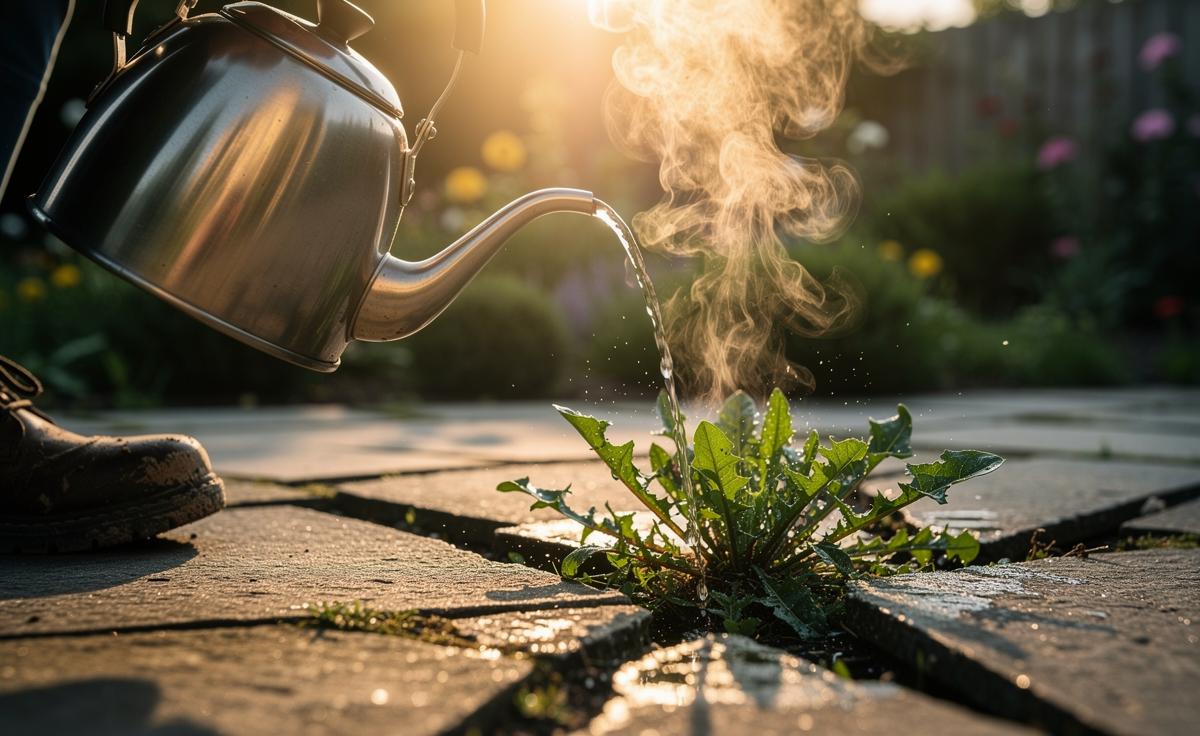
Boil a full kettle or pan and move directly to the target before the temperature drops; time matters. Choose a dry, windless day so the water hits the weed, not your ankles. Pour from a low height with a controlled, narrow stream, aiming for the crown first, then tracing the stems and leaves. For cracks in paving, angle the spout into the fissure to drive heat onto roots. Expect immediate wilting; deeper damage unfolds over the next 24–48 hours. Repeat after 7–10 days on any survivors to exhaust root reserves.
Safety comes first. Wear long trousers, sturdy shoes, and heat-resistant gloves. Keep children and pets away until surfaces cool. Plan your path so you never carry boiling water over your own feet. If you’re working near ornamentals, use a watering can with a rose removed or a kettle with a precise spout. Shield nearby plants with a board or upturned bucket. Don’t add salt or chemicals to the water; you’ll risk soil salinity and damage to surrounding life. Finally, avoid freshly laid resin-bound or delicate surfaces; spot-test if the finish is unknown.
Where Boiling Water Shines, and Where It Doesn’t
On hard landscaping, this method is a star. Think block paving, gravel paths, driveways, and terrace joints where hand weeding is awkward and herbicides drift. A quick kettle run clears seedlings, moss, and algae, making surfaces safer underfoot. Along veg bed edges, it’s a neat way to create a clean margin before mulching. In barked areas, part the mulch first so the heat reaches green tissue, then replace it to suppress new germination. Use it as a precision tool, not a blanket treatment.
It’s less suited to dense lawns and mixed borders where splashback could injure desirable plants. Deep-rooted perennials like dandelion, dock, and bindweed may resprout unless you reapply methodically. For invasive species with legal sensitivities in the UK, such as Japanese knotweed, specialist management is required; hot water will scorch tops but won’t deliver eradication. On very dry soils, the water can sink before it scalds; pre-dampen lightly if needed. Where you need large-area control, mechanical cultivation and mulching outperform kettles for effort and cost.
Results, Follow-Up, and Complementary Tactics
You’ll usually see visible collapse the same day. Full browning follows quickly, and the area looks tidier after a light rake or sweep. If a perennial reshoots, treat the new growth while it’s tender; small leaves are more susceptible. Pair the method with mulch to block light from any remaining seed bank, and edge or re-sand paving joints to reduce germination niches. In beds, finish with a 5–7 cm layer of composted bark or leafmould to keep future flushes down.
As a rule of thumb, two to three applications spaced a week apart will control most targets in cracks and gravel, with tougher perennials needing periodic revisits. Consistency beats intensity: smaller, repeated scalds drain the root’s reserves. If you’re tackling a weedy path weekly, consider alternating with a hoe on warm, dry days; the combination is brutally efficient. Below is a quick-reference table to guide volumes and expectations.
| Target Area | Typical Volume | Effectiveness | Notes |
|---|---|---|---|
| Cracks in paving | 100–250 ml per crack | High for seedlings | Angle spout into joints for root contact |
| Gravel paths | 1–2 L per m² | Moderate–High | Rake aside stones to expose crowns before pouring |
| Bed edges | 0.5–1 L per metre | Moderate | Shield ornamentals; repeat on perennials |
| Deep-rooted perennials | Spot pours, repeat | Low–Moderate | Multiple treatments needed; combine with mulching |
Boiling water weeding is quick, cheap, and satisfying. It lets you target problem spots without resorting to synthetic herbicides, and it delivers instant visual wins on hard surfaces and bed edges. Remember the essentials: precision pouring, repeat treatments for tough roots, and safety every step of the way. Pair it with mulches and good edging to stretch results and reduce future labour. Think of it as a smart tactic in a wider, eco-conscious toolkit rather than a cure-all. Where in your garden could a careful kettle pour make the most difference this week—and what follow-up will lock in the gains?
Did you like it?4.6/5 (25)